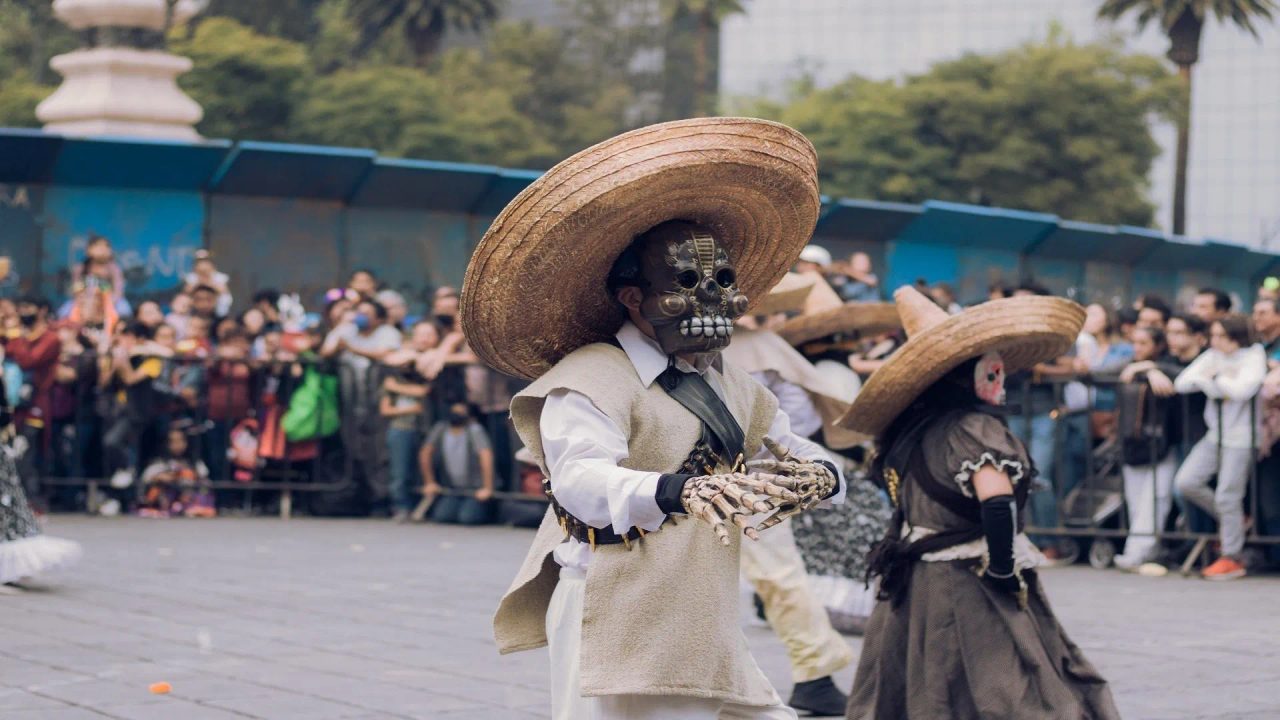
Dia de los Muertos in Mexico is one of the most heartfelt and well-known festivals in the Central American country. Recognized as a UNESCO World Heritage Site in 2008, in Italy it is known as “The Day of the Dead”. It is an event where not only death is celebrated, but also life, in honor of those who are no longer with us, but whose memory must always be cherished.
Told and celebratedrecently, also by the Disney animated film “Coco”, Dia de los Muertos attracts every year tourists from all over the world. During the festival, you can watch and participate in parades and events where people have fun and immerse themselves in Mexican traditions .
During the celebrations, young and old alike dress up as colorful skeletons and parade and dance to the rhythm of music, drinks, and traditional foods. Around them, death is portrayed in a more or less caricatured manner. It is, in fact, a phase of life and should not be feared but accepted with serenity.
Dia de los Muertos in Mexico: Historical Overview
Dia de los Muertos is a genuine cultural heritage for Mexico and has ancient roots. The customs of the time dictated that when a person died, the funeral should be held like a celebration. During the ceremony, relatives had the task of guiding the deceased to Mictlan, the underworld. Additionally, along with the body, food was buried to serve as refreshment for the long journey.
The blending and contamination of indigenous traditions with those brought by the Spaniards during the colonization, led to a mix of religious rites and customs. The inevitable consequence was that the veneration of the dead was incorporated directly into the Christian calendar and coincided with the end of the maize agricultural cycle, which at the time was Mexico’s main crop.
The Day of the Dead celebration thus served to offer the deceased the chance to return home, to the world of the living, if only for one day. In this way, not only did their memory remain alive in the hearts of relatives and friends, but they could share moments of joy and celebration with their loved ones, nourished by the essence of the food offered on the altars erected in their honor.
What has always characterized Dia de los Muertos in Mexico is the unique representation of death. Tradition holds , in fact, that death is not simply considereda mere essence , but a truepresence that materializes in the altar set up by the living, who thus keep eternal the memory of their loved ones. The Iconic Calaveras
The
main symbols of Dia de los Muertos in Mexico are the so-called “Calaveras” , a name derived from theSpanish word “calavera,” meaning “skull” . This image goes far beyond thenormal meaning usually given to it, as it is a recurring presence in many drawings and engravings of pre-Hispanic civilizations, especially the Aztecs and Mayans. Although they are now
common symbols throughout the year, on the day of Dia de los Muertos they become the focal point around which the festival revolves. The Calaveras have the role of reminding people to celebrate life and death and to look to the past and the future, but always rooted in the present In short, they represent a reminder to.
live life to the fullest and encourage us to face difficulties always with a smile. Death is sacred like life, so we must always have faith in the immortality of our soul and welcome death as an old companion The Calaveras are so iconic.
that during Dia de los Muertos they can be found in every form , including food. From candy to chocolateand homemade sweets, they are a constant presence and part of the offerings placed on the altars of the deceased. Dia de los Muertos in Mexico: The Calavera Catrina Among the Calaveras, the
main character
is the Calavera Catrina , the Lady of the Day of the Dead. She is commonly depicted as a woman dressed in French-style clothesand wearing a large hat Her origins also date back to precolonial civilizations.
and, in particular, she is believed to be linked to the Aztec goddess Mictecacihuatl , the queen of the underworld who was tasked with protectingthe bones of the dead. In the early 1900s , the Calavera Catrina also became a
humorous character , thanks to thecartoonist José Guadalupe Posada . In his drawings, the artist used her to “ mock” indigenous peoplewho tried to emulatethe sophistication of Europeans.Discover today our organized trips . You will find many destinations
ideal for every type of traveler. organized trips. You will find many destinations ideal for every kind of traveler.