Want to organize a Safari in Kenya but don't know where to start? Don't worry: we've decided to create this explanatory article on the topic. Kenya safaris are the dream of many, perhaps for a great photographic hunt of the so-called big five (or big 5, as you may call them). These are none other than the five great animals of African wildlife: lion, leopard, African elephant, rhinoceros, and African buffalo.
To experience the joy of a Safari in a place like Kenya, it is not strictly necessary to rely on an agency; it is possible to organize much of the itinerary and handle many needs independently.
In this guide, we at Meeters will explain everything you need to prepare your trip with peace of mind, so you can enjoy the majesty of nature and Africa. The experience we've gained over years of event organization has been useful for gathering all the necessary information to help those who want to make new friends and live unforgettable experiences avoid the most common mistakes.
Follow us to discover which documents are necessary to go to Kenya, why it's important to have health insurance, which park to choose, and the average cost of a safari!
What Documents Are Needed to Travel to Kenya?
Let's start with the boring bureaucratic part: what do you need to go to Kenya?
The most important document is undoubtedly the passport, which must have at least six months of validity remaining from the moment the visa is requested. Additionally, a round-trip plane ticket is required: this will be used to stamp the passport with the entire duration of the stay.
Another essential document to enter Kenya is the tourist entry visa, valid for a duration from 1 to 6 months (the latter only with renewal). The visa costs 40 euros and can be requested on this website.
The last document, necessary to exit Kenya, is the receipt for the exit tax costing 20 €.
What Documents Are Needed to Get a License for a Kenya Safari?
If you want to rent an off-road vehicle, you will need to have an international driving license (valid under the Geneva or Vienna Convention).
This license must be requested at your local motor vehicle office by presenting several documents. The required documents are:
- Proof of payment of €10.20 to account 9001
- Proof of payment of €16.00 to account 4028
- €16 revenue stamp
- 2 recent passport photos (one must be authenticated, this can be done at the motor vehicle office)
- front and back photocopy of a valid driving license
- front and back photocopy of a valid health insurance card
- Request form TT746 (available at the motor vehicle office), properly completed and signed
Health Insurance and Vaccinations: What You Need to Know?
When traveling, it's always important to be informed about everything necessary to avoid potential health problems.
In Kenya's case, it's good to be prepared on two different topics: health insurance and vaccinations.
What Health Insurance Is Necessary to Travel to Kenya?
Let's be clear: it's unrealistic to expect European-level hospital care in Kenya. Healthcare is entirely paid out-of-pocket, and to receive treatment comparable to what we know in Italy you need to pay significant amounts.
Additionally, just like in America, in case of hospitalization or urgent interventions, hospitals require a guarantee of coverage via credit card or health insurance.
For this reason, health insurance, although not formally mandatory, is extremely important to avoid unpleasant surprises.
Which Vaccinations Are Important for Those Traveling to Kenya?
There are no mandatory vaccinations to go to Kenya, only recommended ones. We suggest monitoring the ViaggiareSicuri website and hovering over Kenya to check for specific indications.
Which vaccinations are recommended? We always advise contacting your primary care physician to determine which are most suitable and important based on your health conditions.
The most likely ones are three: antimalarial prophylaxis, IPV vaccine (inactivated polio vaccine), and hepatitis A and B vaccines.
What Is the Best Time to Go on a Safari in Kenya?
Organizing a safari means being outdoors all day, battling the scorching sun and certainly unfriendly temperatures of this part of Africa. For this reason, it's important to know the best months to plan your trip and embark on an adventure amid the wonderful savanna landscapes.
In Kenya, there are two different periods: the dry season from October to March and the wet season from April to September. Within these periods, there are two rainy seasons: the first from March to May (long rains) and the second from October to December (short rains).
Kenya's varied climate significantly impacts the country's ecosystem and economic activities, particularly agriculture and tourism. During the long rains, abundant precipitation promotes lush vegetation growth, making this period ideal for farmers cultivating maize, tea, and coffee. However, heavy rains can also cause flooding and make travel difficult in rural areas.
The short rains, though less intense, are crucial for replenishing water reserves and allowing a second annual harvest. On the other hand, the dry season is particularly favorable for tourism, with national parks and nature reserves becoming more accessible and wildlife gathering around the few remaining water sources, offering spectacular viewing opportunities for safari enthusiasts.
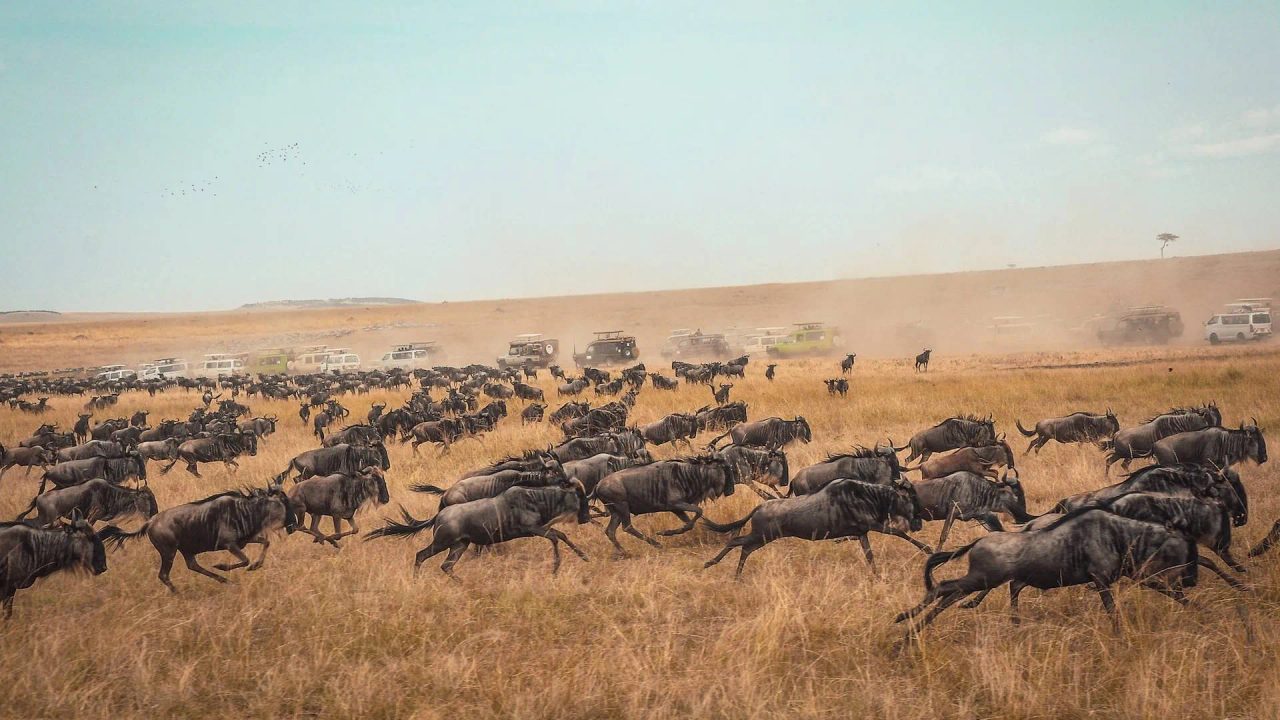
Given this data, it's needless to say that the best time to go to Kenya to discover the most beautiful safaris in Africa and their magic is undoubtedly between June and September. This period coincides with the migration of the wildebeest moving from Tanzania to Kenya's Masai Mara; essentially, a perfect summer vacation stop!
Where to Go on a Safari in Kenya?
Now we come to the penultimate section of this article: what are the best places to go on Safari in Kenya?
Usually, the best options for those wanting to experience the thrill of a safari in Kenya are three: Tsavo National Park (East/West), Amboseli National Park on the border with Tanzania, and the Masai Mara Nature Reserve, crossed by the Great Rift Valley.
Tsavo Park is the largest in all of Kenya, so much so that it is divided into Tsavo East and Tsavo West. The park is huge, but that doesn't stop visitors from encountering many animals: besides the big five, it's very easy to spot hyenas, giraffes, impalas, or zebras; the atmosphere in this place is truly mystical and could really surprise anyone.
Amboseli, on the other hand, is the name of the park that includes a side of Mount Kilimanjaro, the highest peak in Africa. This park is perfect for those wanting to see a large number of African elephants, which are more common and easier to spot here than in other parts of Kenya.
Moreover, Amboseli offers a unique natural spectacle thanks to the presence of swamps and wetlands fed by underground springs flowing from Kilimanjaro. These habitats provide refuge to a wide range of wildlife, including buffalo, impalas, lions, and cheetahs, making the park a favorite destination for safari lovers. Not only the fauna but also the flora is extraordinary: acacias and palm trees dot the landscape, offering shade and an ideal habitat for many bird species. The view of the snow-capped Kilimanjaro towering against the blue sky, with elephants grazing peacefully in the foreground, is one of the most iconic and unforgettable images you can capture in Africa.
The Masai Mara Nature Reserve, instead, is a vast prairie crossed by the Great Rift Valley. The richness of ecosystems here is unprecedented, with hundreds of different species among amphibians, reptiles, birds, and mammals. The real spectacle is the great migration of the wildebeest that from June to September move from Tanzania to Kenya (then return back in September).
How Much Does It Cost to Organize a Safari in Kenya Independently?
Of all the experiences you can organize in Africa, a safari trip is definitely one of the most expensive. The reasons are simple: national park entrance fees are quite costly, with prices ranging from 50 to $100 per day (depending on the park chosen).
On top of these prices, you must add the cost of maintaining the jeep, including fuel, maintenance, and possibly a driver. This clearly increases the costs further.
Roughly speaking, it all depends on who organizes the trip: asking for help from an international or Italian agency will certainly raise the price (but simplify communication), while doing it with a local agency will keep prices down (but complicate any changes).
Between airfare, safari expenses, food, and accommodation, it's reasonable to expect a cost ranging from 1,000 to 3,000 euros, depending on what you want to do, how long the trip lasts, and so on.