There are cities that can move us just by their name and Marrakech is one of them. Just hearing it mentioned, the most famous and important of Morocco’s four imperial cities evokes colors, sounds, and atmospheres that transport us into vivid daydreams. Visiting Marrakech on an organized trip is a great way to venture through the stunning landscapes of a land that often seems so far away, yet is closer than we think. This Berber-origin city is the best starting point to understand the many influences and inspirations that have shaped, and continue to shape, Moroccan history and culture.
So let’s embark on a virtual tour of the city and see what absolutely cannot be missed to make your trip to Marrakech a complete experience!
Djemaa el Fna
The first stop on our Marrakech itinerary is Djemaa el Fna, the main square of the medina, or old city. The Place, as it is also known, is the nerve center of Marrakech, where you can truly understand how and why the city is considered a crossroads of peoples and cultures.
At any hour of the day or night, Djemaa el Fna never sleeps; it is constantly filled with people, artisans, street performers, dancers, fortune tellers, and animal trainers, including monkeys, snakes, and iguanas.
Contrary to what one might think, this square is not primarily tourist-oriented but has maintained a pure and traditional character, while absorbing the many influences from Africa to Europe that have animated it over the centuries.
Our advice is not to limit yourself to just a quick visit. Instead, return again and again to truly discover how life in Marrakech’s society unfolds and changes throughout the day.
The Souks
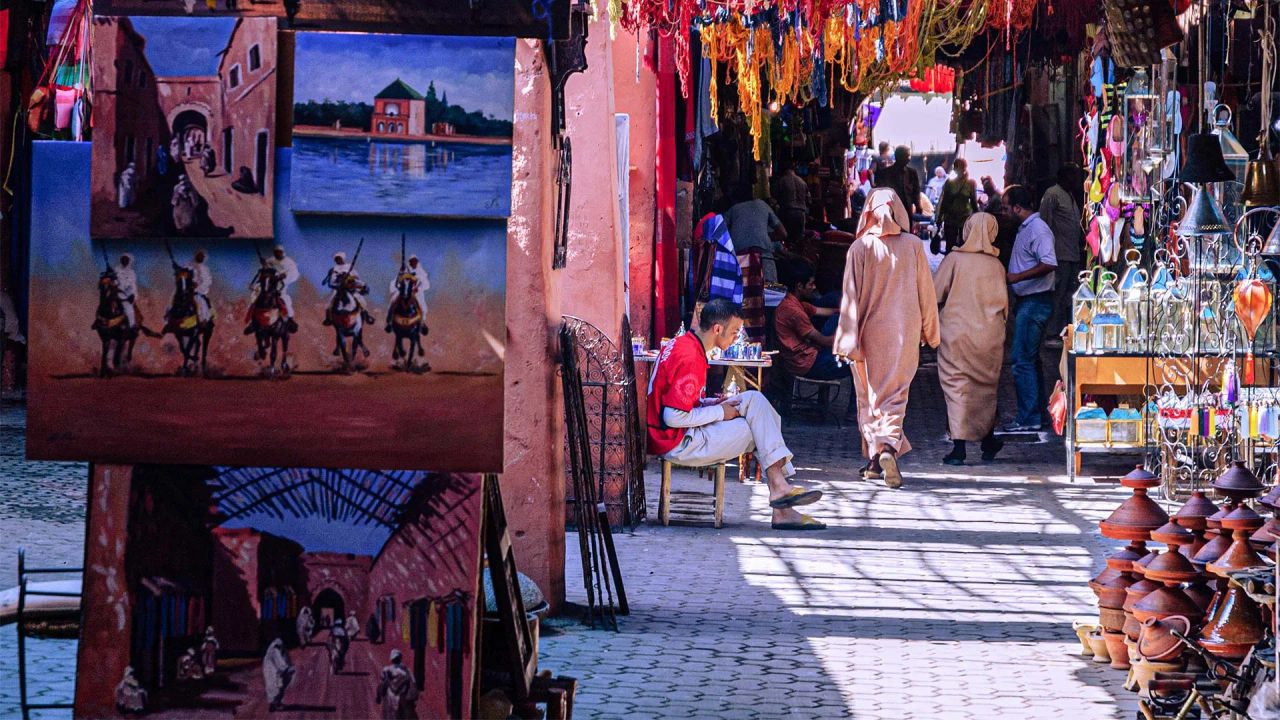
The same applies to the souks of Marrakech as we just said about Djemaa el Fna. In any Moroccan city, Morocco you will find these large open-air markets made up of a maze of alleys that intersect and chase each other, where you can buy virtually anything.
When exploring Marrakech on an organized trip, getting lost in the souks is quite easy, as is finding your way out! But if you want to establish a more genuine connection with the city and its beating heart to uncover all its secrets, let yourself be guided not so much by a guide, but by your own feelings.
In the souk, you can also sample some typical local dishes and get a broad view of the many forms Moroccan craftsmanship takes.
Koutoubia Mosque
The Koutoubia Mosque, or Kutubiyya, is one of the most beautiful buildings in the city. Its name can be literally translated as Mosque of the Booksellers because, according to tradition, nearby there were souks where sacred books were sold.
The mosque, whose construction began around 1120, is a splendid example of Almohad Islamic architecture. The building consists of a large courtyard overlooking the vast prayer hall, but its symbol is the minaret, nearly seventy meters tall, decorated with arabesques and friezes of white, turquoise, and blue tiles.

Saadian Tombs
Inside the walls of the lower medina, just a few steps from the Kasbah Mosque, are the Saadian Tombs, one of the country’s most interesting and astonishing archaeological complexes.
The Saadian necropolis was discovered in a state of total abandonment around 1917 by a group of French archaeologists, who immediately understood the historical significance of their find. The funerary complex was built during the 1500s by order of the Saadian sultan Ahmed el-Mansour ed Dahbi, but it also includes tombs predating his reign.
Among the various tombs stand out the finely decorated mausoleums of prominent family members. However, the less luxurious graves also make a strong impression, thanks to the colorful tiles made with the zellige technique forming geometric patterns.
Majorelle Gardens
The Majorelle Gardens are among the most recent attractions in Marrakech, but that does not make them any less charming.
During 1919the French colonial period, the artist Jacques Majorelle visited Marrakech and fell in love with it so much that he moved there. After purchasing a palm grove in the northern part of the Medina, he began work on building a villa where Art Nouveau style meets Moorish design. The building was painted in a characteristic deep blue color that still stands out today.
This concludes our Marrakech itinerary with an organized trip, but keep following our blog for more guides and tips!