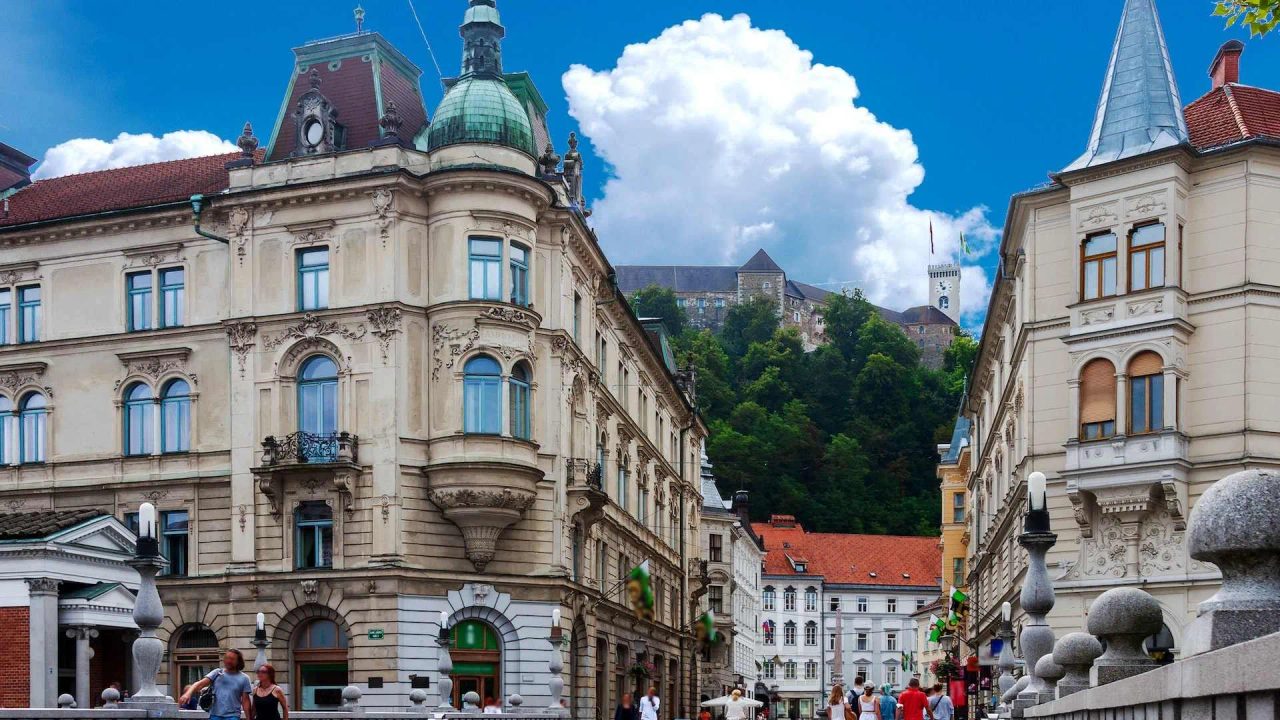
The small capital of Slovenia, Ljubljana, is a city very close to northern Italy in atmosphere and spirit, yet it hides many surprises within. We’re talking about a place reachable within 5 hours by car from Milan, not exactly an exoticdestination! This naturally raises a very specific question: what to see in Ljubljana if you decide to visit?
Well, that’s where we come in: Ljubljana is a charming, peaceful city with a touch of liveliness: there’s the splendid Ljubljana Castle, many squares to explore, parks to visit, and views to soak in — everything you need to bring home wonderful memories.
At Meeters, we have considerable experience with vacations: we organize events for several years and strongly believe in the possibility for people to make new friends through shared experiences. For this reason, today we’ll take a closer look at how to approach Slovenia’s capital, whether on foot, by bike or by public transport.
Tivoli Park
Let’s start right away with the city’s green lung: among all the things to see in Ljubljana, this is one of the easiest to engage with. Not far from the center, near one of the city’s large parking lots, Tivoli Park is the perfect place to relax, stroll, and stretch your legs after a trip..
Among the park’s attractions, you can find a small botanical garden, an outdoor Olympic-sized swimming pool, and an art gallery located inside Tivoli Castle.
The park also features a special path called Jakopic Walk: it’s common to come across photography exhibitions here throughout the year. Jakopic: It is very easy to come across photography exhibitions here throughout the year.
St. Nicholas Cathedral
Right in the historic center and for just 2 euros, you can visit St. Nicholas Cathedral, the town’s jewel built in the Baroque style.
St. Nicholas Cathedral is quite striking, with two towers and a green dome dominating the skyline. Its interior, however, surprises even those familiar with Italian churches: countless frescoes and numerous sculptures. Walking along the side aisles, you can closely observe paintings by Giulio Quaglio and sculptures by Angelo Putti and Francesco Robba.
One important note for visiting this cathedral: remember it’s open daily but only from 10:00–12:00 and 15:00–18:00!
Central Market
Ljubljana’s central market is definitely one of the city’s most interesting attractions. What to see in Ljubljana if not a riverside market packed with everything imaginable, mainly frequented by locals and capable of creating a tangible atmosphere of relaxation?
The central market is divided into three sections: the open kitchen (odprta kuhna), the actual outdoor market, and the covered market, built between 1940 and 1944 by architect Jože Plečnik.
The open kitchen runs from mid-March to the end of October every Saturday and is a recurring event where local Slovenian chefs enjoy preparing dishes from all over the world; the outdoor market mainly focuses on food. The covered market, on the other hand, has shops and restaurants upstairs and on the ground floor an art gallery (dobravaga) and a seafood restaurant.
Ljubljana Library
Back to Jože Plečnik to talk about Ljubljana Library, also known as NUK.
This library is one of the city’s most important works and is an imposing rectangular building with four floors, its facade decorated with red bricks and stone blocks placed irregularly: this irregularity is one of the elements that most define its charm.
The library’s interior is no less impressive: it includes a huge central staircase in dark marble, accompanied by 32 columns leading to the main reading room, the only area requiring a ticket.
The reading room is open only on Saturdays from 14:30 to 18:00; the rest of the library is free to visit from 10:00 to 18:00 except Sundays.
The atmosphere inside Ljubljana Library is solemn and enchanting, with an aura of tranquility and focus enveloping every visitor. The walls are lined with shelves containing a vast collection of books and manuscripts, many dating back centuries, making it a place of great historical and cultural importance. Natural light filters through large windows, creating a play of shadows and reflections that enhances the building’s architectural beauty.
Besides the main reading room, the library hosts various study rooms and research areas, each with its own distinctive character. The furnishings are elegant and functional, designed to offer maximum comfort to scholars and readers. There are also spaces dedicated to cultural events, conferences, and temporary exhibitions, making the library a lively and dynamic hub for the local community and international visitors alike.
Ljubljana Castle
On top of Grajska Planota stands a castle, Ljubljanski grad, the city’s oldest and most important. Fortified during the 14th century to protect the settlement from Turkish raids, the castle has continuously changed shape and function over the years: from fortress to noble residence, then military warehouse, and finally used as a prison during the 18th and 19th centuries.
Today, this castle is one of the most important tourist destinations in Slovenia’s capital: it is fully visitable and houses a puppet museum and a Slovenian history museum. You can reach the castle on foot or by funicular, for which a special combined ticket is available.
Miklosiceva Cesta
Just outside Ljubljana’s historic center is a street not to be missed: along Miklosiceva Cesta, there is an entire block of Art Nouveau buildings.
These streets are especially beautiful to see because they offer a glimpse into the architecture of a truly original place; the highlight, among other things, is the cooperative bank: a building with a pink facade and geometric ornaments that take on the colors of the local tricolor. There are many other things to see in Ljubljana, but these are more than enough reasons to book your stay!