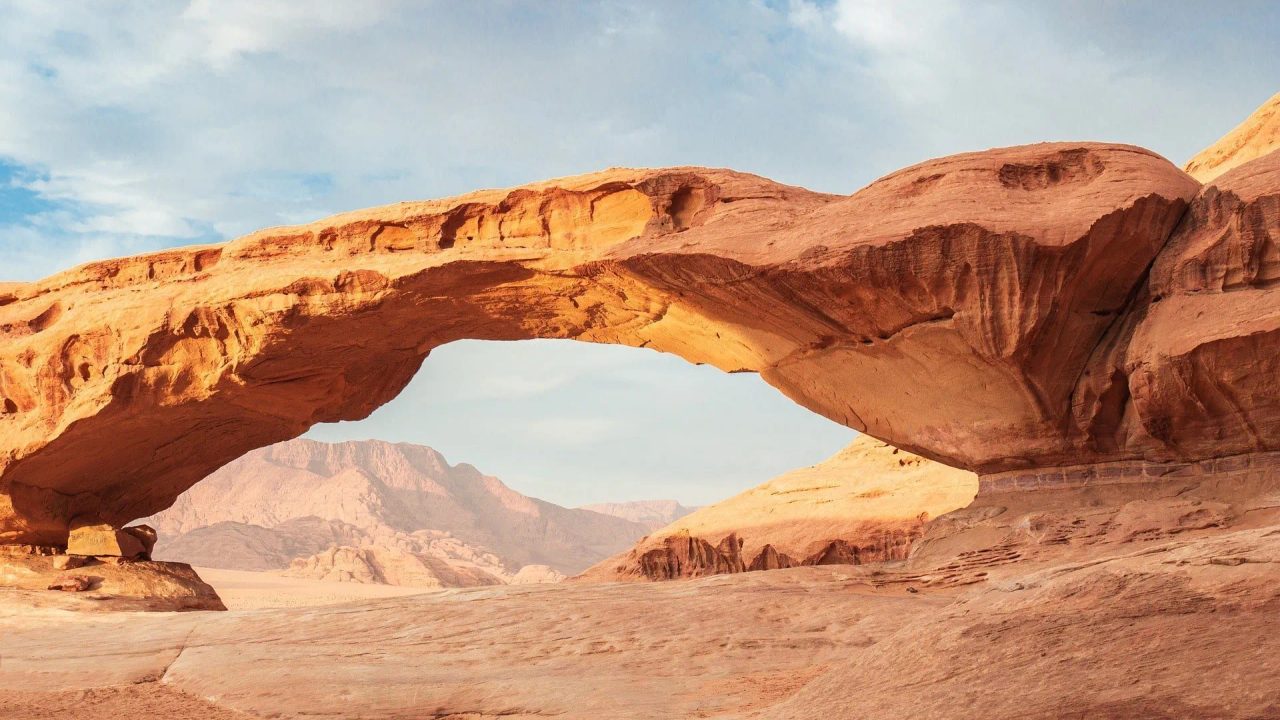
At an altitude between 700 and 1200 meters east of the Jordan River, which gives it its name, lies an area of millennia-old charm. This is Jordan. If you have decided to read this article, you are probably wondering what to see in this magnificent part of the Middle East.
You’re in the right place: get ready to discover the landscapes, itineraries, and key attractions that make a trip to Jordan unforgettable, keeping in mind that some times of the year are better suited for visiting this country.
Jordan is perfect for amazing photos and footage. For this very reason, director Denis Villeneuve chose to film Dune , the successful 2021 movie., a hit film from 2021.
[maxbutton id=”3″ ]
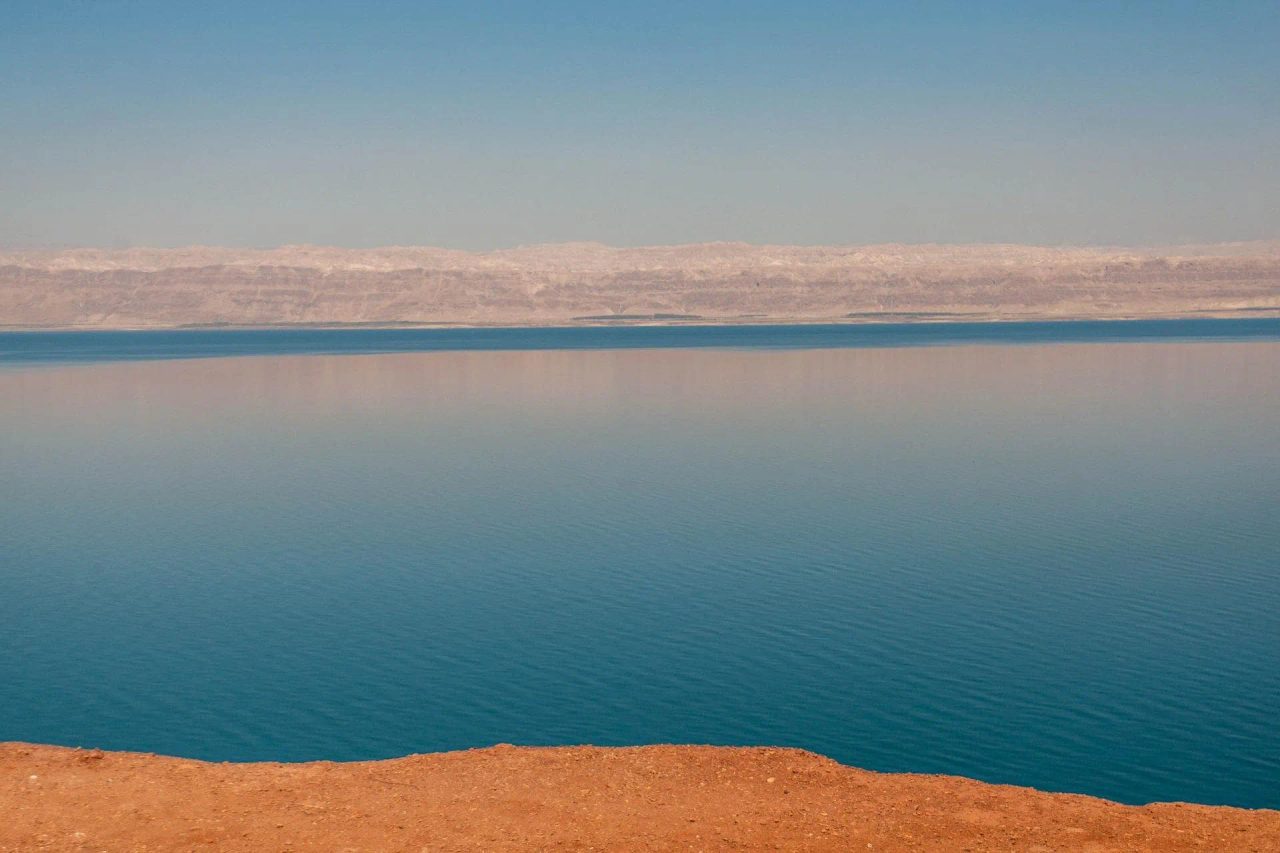
One of its most famous attractions is the Dead Sea, where you can bathe and float blissfully on its waters known for their high salt content. The red sand of its deserts attracts visitors from all over the world, and its historical monuments are of crucial importance to the entire world..
Biblical Traces
Jordan is well known as one of the central locations in biblical narratives.
The great canyon of the Wadi Mujib, which flows into the Dead Sea, is crossed by the Arnon River mentioned in sacred texts. And the Mount Nebo, in western Jordan, is identified as the peak where God showed Moses the Promised Land.
[activecampaign form=22 css=1]
Petra, the Pink City Not to Miss A stop that cannot be missed on a trip to Jordan is Petra. The village surrounding it is called Wadi Musa, the “Valley of Moses”: it is the most modern and urban part of Petra.
Its
Ancient City instead, with its archaeological site and buildings of extraordinary austerity, has the power to evoke feelings of extreme wonder. In front of Petra, a true man-made jewel, travelers immediately understand why this historical testimony is part of the
Seven Wonders of the World and the sites designated as UNESCO World Heritage. Petra is famous for its
resilience . It dates back to 300 BC and has managed to remain intact over time, despite the difficulties and misfortunes it faced throughout history.. It dates back to 300 BC and has remained intact over time, despite the challenges and misfortunes it faced throughout historical eras.
The Siq, the Gorge Leading to the Ancient City
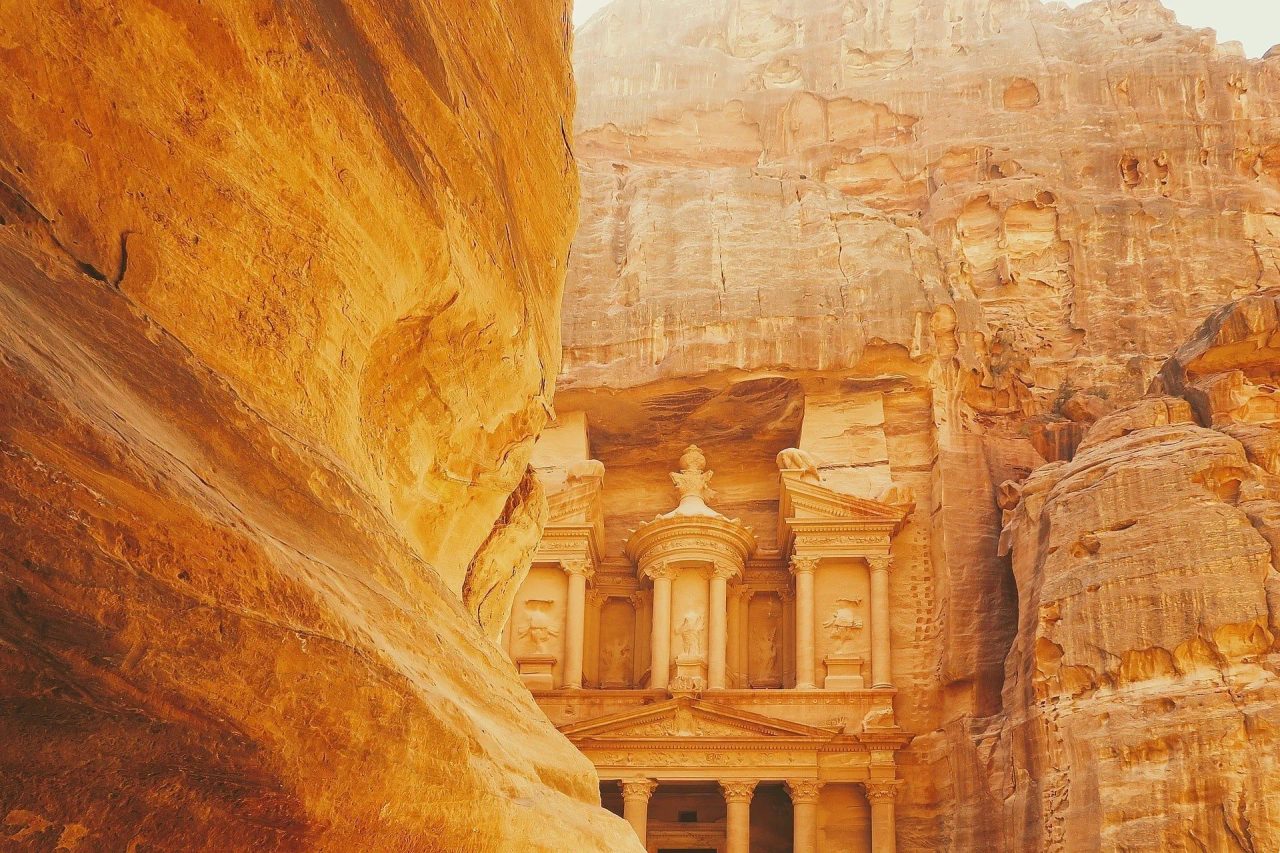
We recommend reaching Petra’s Ancient City through the Siq, a 1.2-kilometer-long and 200-meter-high fissure. In ancient times, this corridor served as a sacred path where the city’s most important rituals took place. At its entrance, you will find the remains of a monumental arch.
Walking through it allows you to experience the hydraulic engineeringof the Nabatean kingdom, an ancient people devoted to trade between Syria and Arabia: dams, canals, aqueducts, rainwater collection systems, and other evidence of their advanced civilization line the entire Siq corridor. of the Nabatean kingdom, an ancient people dedicated to trade in the area between Syria and Arabia: dams, canals, aqueducts, rainwater collection systems, and other evidence of their advanced civilization dot the entire Siq corridor.

views of the city , which is partly hidden and gradually revealed as you slowly approach your destination.Once you reach the point where the walls seem to almost touch, the Treasury will appear before your eyes.
[maxbutton id=”3″ ]
The Treasury and the Monastery
Al-Khazneh
, the local name forthe Treasury , with its Hellenistic-style facade, is a temple that inspires great awe.It is carved, like a bas-relief, into a ferruginous sandstone cliff,
pink in color : hence the nickname “Pink City.” A legend says it was the hiding place of a treasure belonging to an Egyptian pharaoh. What is certain is that it houses the tomb of the Nabatean king Aretas III, from the first century BC.: hence the nickname “The Rose City.” A legend says this is the hiding place of a treasure belonging to an Egyptian pharaoh. What is certain, however, is that it houses the tomb of the Nabatean king Aretas III, from the first century BC.
capture the facade of the Treasury we recommend doing so between nine and eleven in the morning, when it is most exposed to sunlight. Among Petra’s legendary monuments is the
Monastery, locally known as Al-Deir. 900 steps lead you to this place with an incredible view, which you can enjoy while sipping tea at a nearby kiosk.The Monastery is a larger version of the Treasury, with a similar structure, columns, and Hellenistic facade. It dates back to the 3rd century BC and also served as a
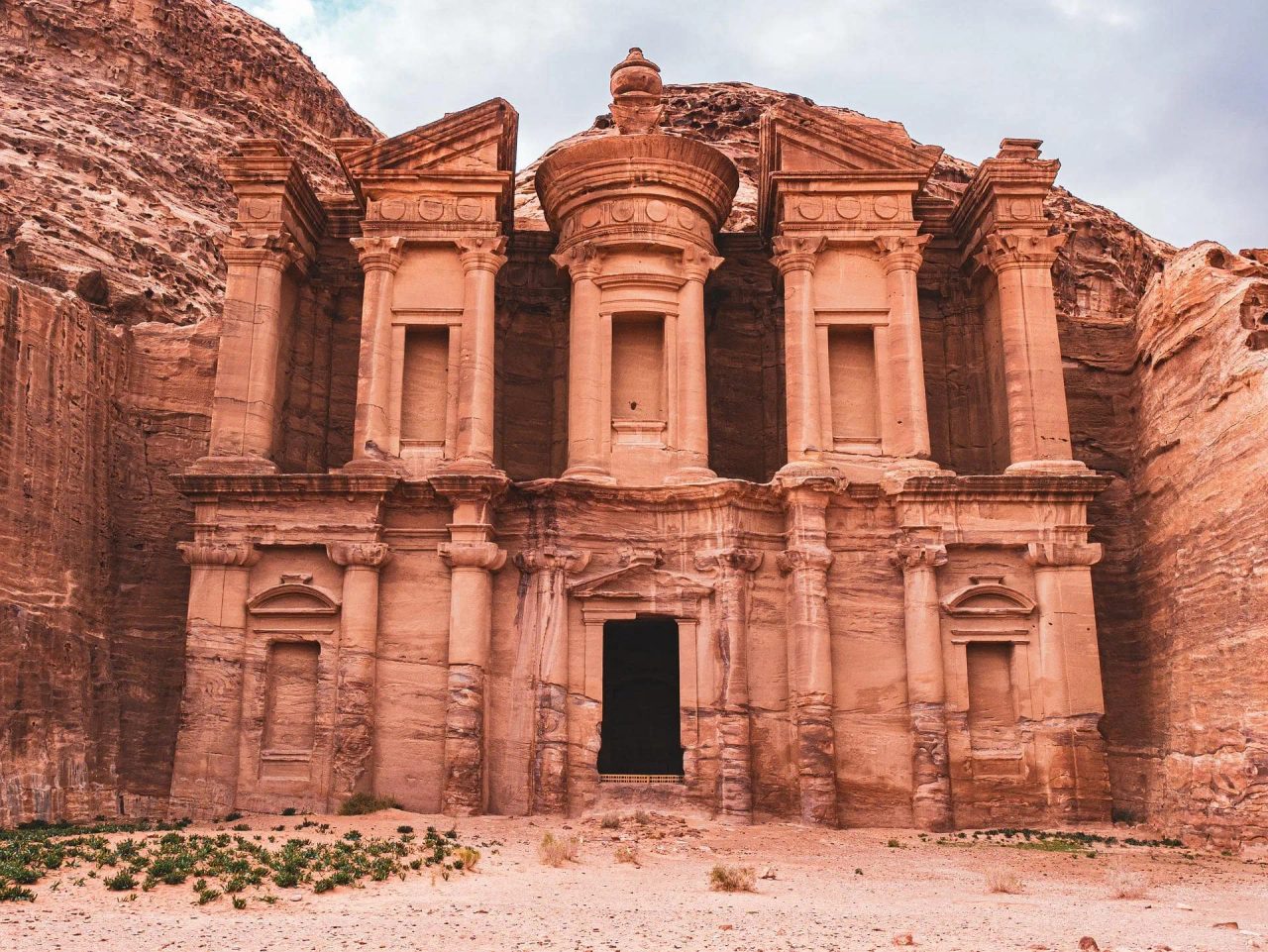
royal Nabatean tomb. Inside, on its walls, you can admire crosses
. These decorations, probably from the Byzantine era, give the building its name, as it is thought to have been used as a church. The courtyard in front also had a ritual function. Late afternoon and sunset are the best times to visit, as the sun’s rays andplay of light and shadow
fantastically paint the pink hues of its facade. From the Treasury, you can reach viewpoints overlooking the Wadi Araba desert stretching to Israel and Palestine, and Mount Jebel Haroun, with its small white sanctuary. A lesser-known path leads to the gorge where the Tomb of the Lions
From the Treasury, you can reach viewpoints overlooking the Wadi Araba desert stretching to Israel and Palestine, and Mount Jebel Haroun, with its small white sanctuary. A lesser trail leads to the gorge where the Finally, from this point, you can reach Siq al-Barid, known as.
Little Petra, another must-see stop for visitors to Jordan.The Wadi Rum Area
Rocky Gorges and Copper Sand
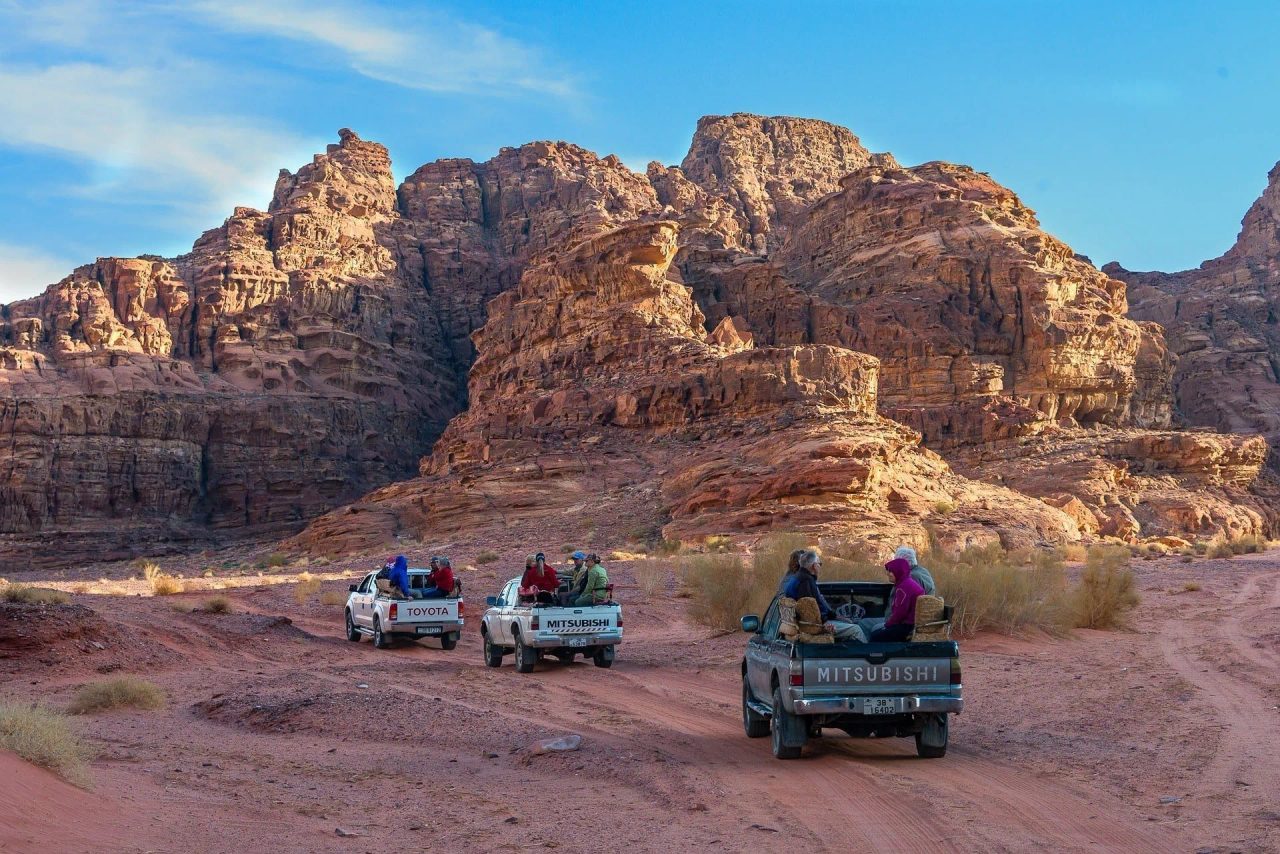
are constants in Wadi Rum, a protected area and home to Bedouins. This desert valley is highly appreciated by travelers seeking adventure. In Wadi Rum, also called the
Valley of the Moon, you can choose to spend the night under the starry sky, camping among the dunes. One of the most striking points of interest in the Wadi Rum desert is the
Mountain of the Seven Pillars. It is a reddish-hued rock formation connected to another mountain with twenty peaks, theJebel Umm Ishrin, known as “the Mother of the Winds.” The latter has a legendary story: the “
Mother of the Winds” was a woman who killed all her suitors except the twentieth, who proved to be the cleverest and thus an ideal husband.Wadi Rum’s rocky walls feature several
water springs, including Lawrence’s spring, named after British writer T. E. Lawrence who mentioned it inSeven Pillars of Wisdom. This particular water source.
smells of wild mint and is quite small, about one and a half meters. It is located near the ruins of an ancient temple dating back to the Nabatean rulers, offering an extraordinary viewpoint. A truly refreshing stop. and it is very small, about one and a half meters. It is located near the ruins of an ancient temple dating back to the Nabatean rulers, offering an extraordinary viewpoint. A truly refreshing stop.
If you go to Jordan, you cannot miss a visit to its capital,Amman. The city is built on hilly terrain and is relatively young. Here you can experience the, most authentic Jordan,in contact with its people and daily life.Often this destination is chosen as a stopover between Petra and Wadi Rum, precisely because it allows you to slow down and enjoy a moment of rest without giving up beauty.
The city’s affluent residential neighborhoods host art galleries and shopping centers, while the
lively city center is filled with souks, cafes, and mosques. The Citadel, Ruins in Amman
Right in the center of Amman, on the city’s highest hill, stands
the Citadel, surrounded by 1700 meters of walls. It preserves evidence evoking various eras, from the Bronze Age to Roman, Byzantine, and Umayyad periods.Of the
Roman Temple of Hercules, built under Emperor Marcus Aurelius’ rule, only two columns and a large stone hand remain.The
Umayyad Palace is what remains of the royal buildings constructed by the dynasty that ruled Amman around 720 AD. The Audience Hall, topped by
a dome with a stunning visual effect, is followed by a courtyard and a street decorated with arches and columns, where some residential buildings can be admired. From here, you reach the Throne Hall. The palace also houses a circular Umayyad cistern, which in the past served as a water reserve for the surrounding area.
The Roman Theater, a Jewel of the City
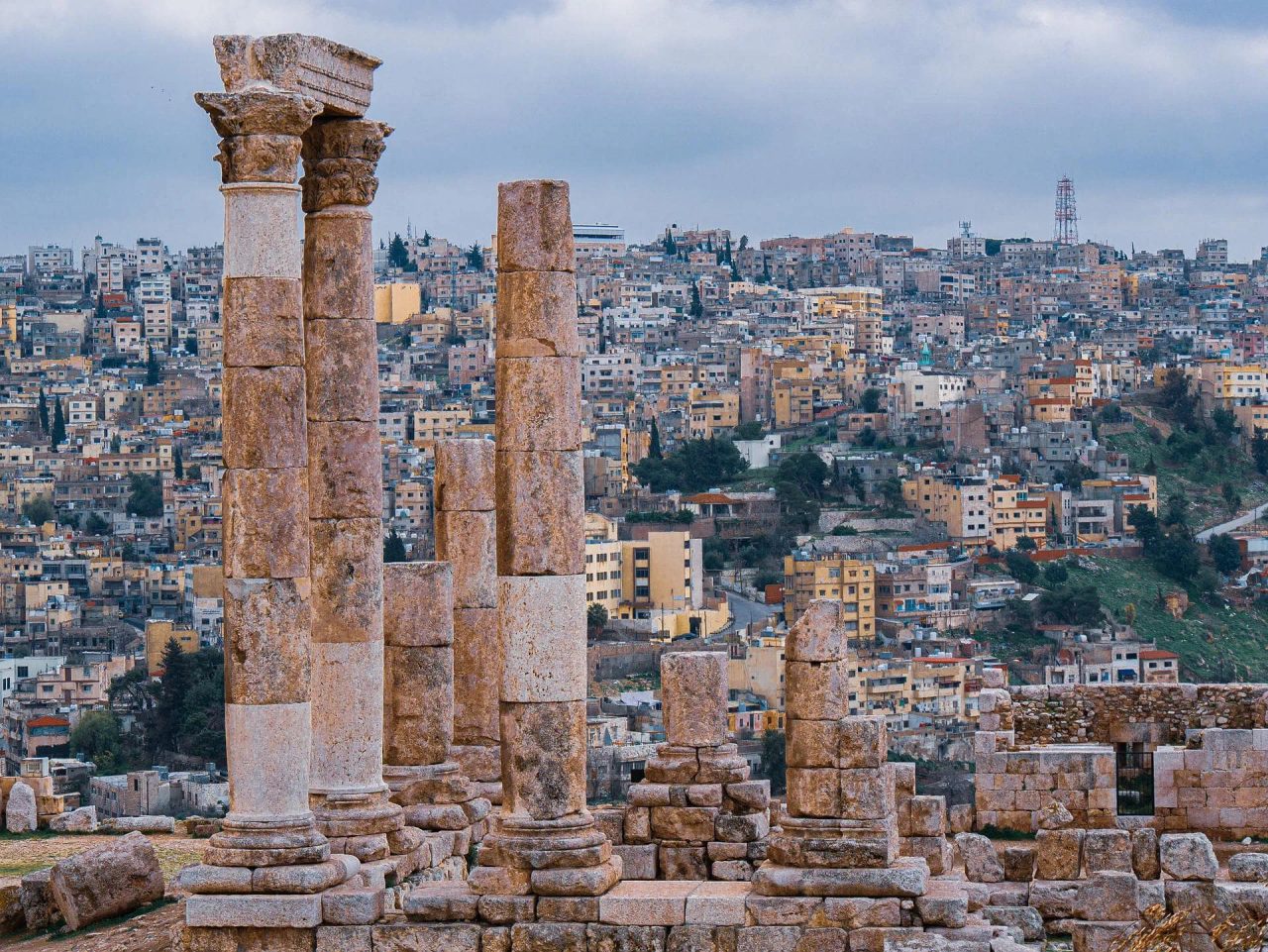
What has remained well preserved in Amman over the centuries is the Roman Theater,
carved into the hillside. The site is quite photogenic in the morning, the ideal time to photograph it, while the sunset lights enhance the view from above.It is believed to have been built in the 2nd century AD under the reign of Antoninus Pius. Its stands, with
6,000 seats, are arranged in three tiers: authorities sat closest to the stage, followed by the military in the central section, and the people higher up.Like all ancient theaters, Amman’s was a place where
sacred rituals related to city life took place. Today all community experiences, abroad or locally, are perfect for those who love exploring new places with new people.[maxbutton id=”3″ ]
[maxbutton id=”3″ ]